
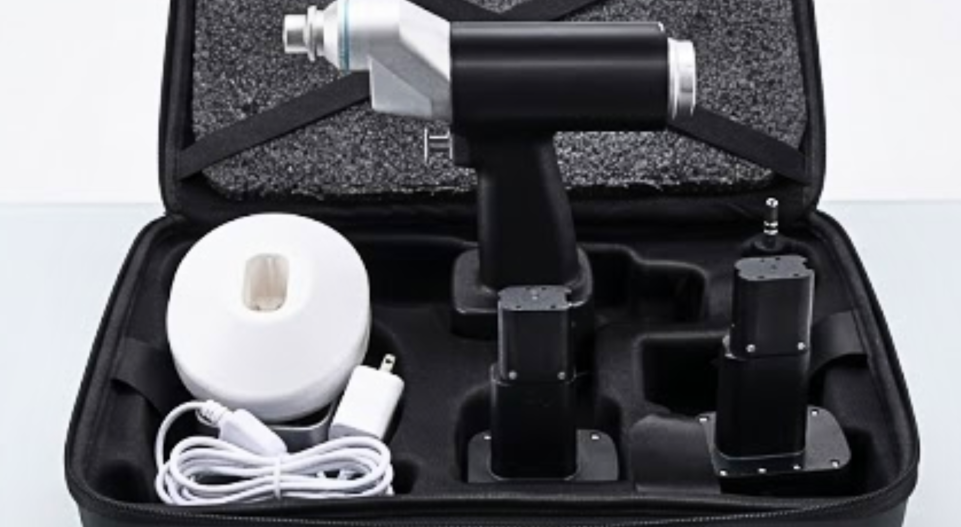
However, a cannulated drill machine is an orthopedic surgical power tool for controlled bone drilling and guide-wire alignment. Unlike a conventional orthopedic drill, a cannulated system incorporates a hollow pathway through the relevant handpiece or attachment, depending on the design, allowing compatible wires or guides to be accommodated during orthopedic procedures.
Additionally, cannulated drilling systems are used in orthopedic trauma surgery and K-wire procedures for accurate drilling and compatibility. Additionally, depending on the model, a system may offer variable speed and forward and reverse operation.
If you are comparing an orthopedic cannulated drill, looking for a cannulated surgical drill, checking the cannulated drill price, or planning to buy a cannulated drill, it is important to evaluate more than just the quoted price.
Firstly, what is a cannulated drill machine?
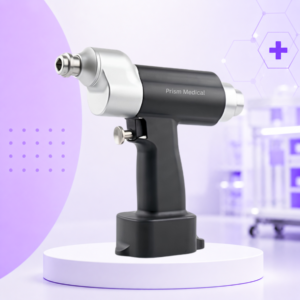
Additionally, a cannulated drill machine is an orthopedic power tool designed to drill with a guide-wire to maintain trajectory.
The term “cannulated” generally refers to the hollow or cannulated design that allows compatible wires or instruments to pass through the system. However, exact cannulation dimensions and compatibility depend on the manufacturer and model.
For example, commercially available systems can differ in cannula diameter, operating speed, torque, chuck type and compatible attachments. In addition, models optimized for trauma applications may accommodate K-wire drivers, drill chucks, or flexible reamers.
Additionally, why is cannulation important?
Additionally, in orthopedic procedures, maintaining an appropriate drilling trajectory can be important for accurate placement of fixation devices. A cannulated system can support a wire-guided workflow when the selected drill, wire, attachment and surgical technique are compatible.
However, cannulation alone does not guarantee surgical accuracy. Therefore, proper instrument selection, imaging, surgical technique, compatibility and manufacturer instructions remain essential.
Firstly, how does an orthopedic cannulated drill work?
Additionally, the basic workflow depends on the surgical procedure and the specific cannulated drill system.
In practice, a typical wire-guided drilling setup may involve:
- Placement of a guide-wire or K-wire according to the surgical technique.
- Additionally, ensure the compatible cannulated drill or attachment is positioned over the guide-wire.
- Next, ensure controlled drilling using the appropriate speed, torque, and drill accessory.
- Monitoring of the drilling trajectory according to the procedure and clinical protocol.
- Remove or exchange the instrument after completing the required preparation.
Additionally, different systems have different cannula dimensions and attachment configurations. Some commercially available cannulated drills, for example, specify cannula diameters around 4–4.5 mm, while other systems may have different dimensions.
Therefore, the actual surgical technique should always follow the relevant implant system, instrument manufacturer’s instructions, and the surgeon’s established protocol.
Moreover, Key Features to Look for in a Cannulated Surgical Drill
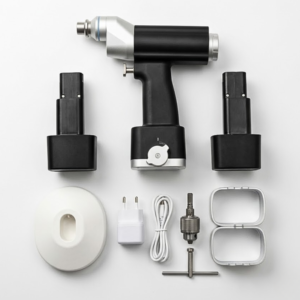
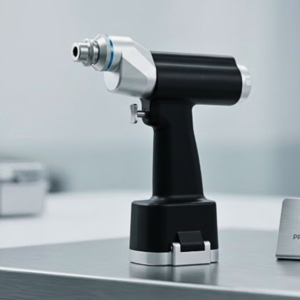
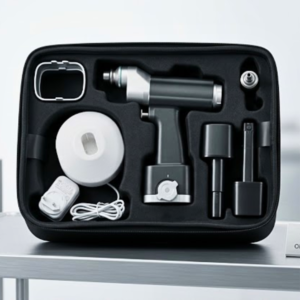
If you are planning to purchase a cannulated surgical drill, compare the following specifications rather than choosing a machine based only on price.
1. Variable Speed Control
Therefore, variable speed allows the operator to select an appropriate operating range for the intended application.
However, available models can have substantially different speed ranges. For example, some systems advertise speeds up to 800 or 1,200 RPM, while other models list higher maximum speeds.
Therefore, you should evaluate the maximum RPM together with torque, intended application, and compatible accessories.
2. Torque
Torque is another important specification when comparing orthopedic power tools.
A drill with suitable torque characteristics can provide the required mechanical performance for its intended application. However, higher torque is not automatically better for every procedure.
When comparing products, review the manufacturer’s stated torque and operating conditions rather than relying only on the RPM figure.
3. Cannulation Diameter
We consider the cannulation diameter particularly important when the system is intended for use with K-wires or guidewires.
Different products specify different cannula sizes. Therefore, confirm:
- Cannulation diameter
- Compatible K-wire/guide-wire size
- Compatible drill bit size
- Attachment compatibility
- Manufacturer’s recommended accessories
However, clinicians should not treat this as a universal standard.
4. Additionally, the fast-connect system.
A quick-coupling mechanism can make attachment changes more convenient during procedures.
Depending on the system, available attachments may include:
- Drill chuck
- K-wire attachment
- Reamer attachment
- Saw attachment
- Other specialized orthopedic attachments
Some cannulated systems are specifically marketed with quick-change or quick-coupling configurations.
5. Battery Performance
Battery-operated orthopedic drills can offer greater mobility in the operating environment because they do not require a continuous mains connection during operation.
When evaluating a battery-operated system, check:
- Battery voltage
- Battery capacity
- Number of batteries supplied
- Charging time
- Expected operating time
- Availability of replacement batteries
- Battery sterilization/aseptic transfer requirements
Battery specifications vary significantly between models.
6. Sterilization Compatibility
For reusable surgical instruments, sterilization compatibility is a critical specification.
Some commercially available orthopedic drill systems state compatibility with high-temperature sterilization, with examples specifying temperatures around 135°C. However, sterilization capability is model-specific and must be verified from the manufacturer’s instructions before use.
Do not assume that every battery-operated or cannulated drill is autoclavable.
7. Ergonomic Design
An orthopedic drill should be comfortable to handle and appropriately balanced for its intended use.
Useful design considerations include:
- Handpiece weight
- Grip design
- Trigger control
- Vibration
- Noise
- Balance
- Forward/reverse control
- Attachment-changing mechanism
Some manufacturers specifically highlight ergonomic design, low noise and controlled temperature rise as features of their cannulated drill systems.
Applications of Cannulated Drill Machines
A cannulated drill machine may be used in orthopedic and trauma-related surgical applications where the compatible system and accessories are indicated.
Potential applications include:
Orthopedic Trauma Surgery
Cannulated drills can be used as part of instrument systems for trauma procedures involving bone preparation and fixation.
Fracture Fixation
Depending on the implant system and surgical technique, powered drilling may be required for preparing bone for fixation components.
K-Wire Guided Procedures
A cannulated system can be designed to accommodate compatible K-wires or guidewires.
Intramedullary Nail Procedures
Some orthopedic drill systems can accept flexible reamers or other attachments used in procedures involving intramedullary nails.
Joint and Other Orthopedic Procedures
Certain multi-function orthopedic power systems are marketed for trauma and joint-related applications. However, suitability should always be confirmed against the specific procedure, implant system and manufacturer instructions.
Cannulated Drill vs Conventional Orthopedic Drill
The main difference is the design and intended workflow.
| Feature | Cannulated Drill | Conventional Orthopedic Drill |
|---|---|---|
| Cannulated pathway | Available in compatible system/design | Generally not the defining feature |
| Guidewire/K-wire workflow | Designed for compatible wire-guided applications | Depends on attachment/system |
| Orthopedic trauma applications | Common | Common |
| Variable speed | Model dependent | Model dependent |
| Battery operation | Common in modern systems | Common |
| Quick coupling | Available on many models | Model dependent |
| Reamer compatibility | Available on selected systems | Model dependent |
| Sterilization | Model dependent | Model dependent |
The important point is that cannulated does not automatically mean better. The appropriate system depends on the procedure, required accessories, surgeon preference, implant compatibility and hospital requirements.
How Much Does a Cannulated Drill Cost?
The cannulated drill price can vary significantly depending on the manufacturer, configuration and accessories included with the system.
Current Indian listings provide a useful indication of the market range, but prices should not be treated as fixed because suppliers may update prices, configurations, taxes and availability. For example, current listings from Indian suppliers show cannulated and related orthopedic drill systems at different price points, with some listings around ₹44,000–₹59,000 and other systems priced differently depending on configuration.
Factors That Affect Cannulated Drill Price
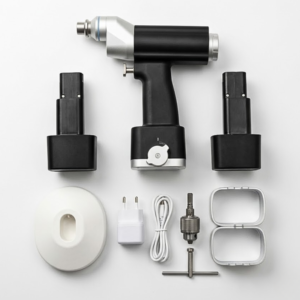
The final price can depend on:
- Maximum RPM
- Torque
- Cannulation diameter
- Battery capacity
- Number of batteries
- Charger
- Drill chuck
- K-wire attachment
- Reamer attachment
- Saw attachment
- Quick-coupling mechanism
- Sterilization capability
- Warranty
- Service support
- Brand/manufacturer
- Certification and documentation
- Complete-set vs handpiece-only configuration
Therefore, when comparing a cannulated drill machine price, always compare the complete configuration rather than comparing only the headline price.
What Should You Check Before You Buy a Cannulated Drill?
Before you buy a cannulated drill, use this checklist:
Technical Specifications
✔ Maximum and variable speed
✔ Torque rating
✔ Cannulation diameter
✔ Compatible K-wire/guide-wire sizes
✔ Drill-bit compatibility
✔ Chuck type
✔ Quick-coupling compatibility
✔ Forward/reverse function
Power System
✔ Battery type
✔ Battery voltage
✔ Battery capacity
✔ Number of batteries
✔ Charging time
✔ Replacement battery availability
Sterilization & Safety
✔ Autoclave/sterilization compatibility
✔ Manufacturer’s sterilization instructions
✔ Aseptic battery transfer system, where applicable
✔ Reusable/single-use components
✔ Operating manual and documentation
Commercial Considerations
✔ Product warranty
✔ Service support
✔ Spare parts availability
✔ Delivery time
✔ GST/tax treatment
✔ Complete set contents
✔ Manufacturer/distributor credibility
This approach can help hospitals, orthopedic departments, distributors and procurement teams make a more informed comparison.
Why Buy from an Experienced Orthopedic Medical Equipment Supplier?

For surgical power equipment, purchasing decisions should consider more than price.
An experienced supplier can help buyers understand:
- Product specifications
- Available configurations
- Compatible attachments
- Warranty terms
- Spare parts
- Service support
- Delivery
- Documentation
- Product availability
For example, Indian medical-equipment suppliers currently list cannulated drills alongside orthopedic drills, bone drills, surgical drill systems and other orthopedic power tools.
For hospitals and professional buyers, it is advisable to request a detailed quotation containing the exact model, included accessories, warranty, applicable taxes and delivery terms before placing an order.
Cannulated Drill Machine for Hospitals and Orthopedic Departments
Hospitals and orthopedic departments may require different configurations depending on their surgical workload.
A basic procurement evaluation should consider:
Clinical requirement → Technical specification → Compatibility → Sterilization → Accessories → Warranty → Service → Total cost
For institutional procurement, technical specifications may be particularly important. For example, hospitals may specify battery-operated cannulated drill systems with particular attachments, coupling systems and compatibility requirements in procurement documents.
A recent 2026 tender from Hamdard Institute of Medical Sciences & Research also demonstrates that cannulated power drill systems are procured for orthopedic operating-room requirements through formal institutional purchasing processes.
Frequently Asked Questions About Cannulated Drill Machines
What is a cannulated drill machine?
A cannulated drill machine is an orthopedic surgical power tool with a compatible hollow/cannulated design that can accommodate a guide-wire, K-wire or other compatible guiding component depending on the system.
What is an orthopedic cannulated drill used for?
An orthopedic cannulated drill may be used for bone drilling in trauma and orthopedic procedures where a compatible wire-guided technique is required.
What is the difference between a cannulated drill and a normal bone drill?
A cannulated drill is designed around a cannulated or hollow pathway for compatible wire-guided applications. A conventional bone drill does not necessarily provide this feature.
What is the cannulated drill price in India?
There is no single fixed price. Current listings show substantial variation depending on the model and configuration. Indian listings currently show several cannulated or related orthopedic drill systems in approximately the ₹44,000–₹59,000 range, while some models may be priced higher or lower. Always request the latest quotation for the exact configuration.
What should I check before buying a cannulated surgical drill?
Check RPM, torque, cannulation diameter, K-wire compatibility, chuck type, attachments, battery specifications, sterilization compatibility, warranty, service support and complete-set contents.
Is every cannulated drill autoclavable?
No. Sterilization capability is model-specific. Some manufacturers specify high-temperature sterilization capability, while the exact method and conditions must be confirmed in the manufacturer’s instructions.
Can a cannulated drill be used with a K-wire?
Some cannulated drill systems are specifically designed to work with compatible K-wires or K-wire attachments. Compatibility depends on the model and accessory specifications.
Where can I buy a cannulated drill?
Hospitals, orthopedic departments and authorized medical-equipment buyers should purchase through a reputable manufacturer, authorized distributor or established medical-equipment supplier. Request the exact model specifications, accessories, warranty and quotation before purchase.
Final Buying Advice
Choosing the right cannulated drill machine is not simply about finding the lowest cannulated drill price.
The better approach is to compare the complete system:
Cannulation + RPM + Torque + K-wire compatibility + Attachments + Battery + Sterilization + Warranty + Service + Total Cost
If you are looking to buy a cannulated drill for a hospital, orthopedic department, trauma center or medical-equipment procurement requirement, shortlist products based on your clinical and technical requirements first and then compare the commercial quotation.
A properly specified orthopedic cannulated drill can be a valuable component of a modern orthopedic power-tool system, but the final product selection should always be based on the intended procedure, compatible instruments, manufacturer’s instructions and qualified clinical/procurement requirements.